Ranked ladders are the default front door to competitive gaming. They ask for a queue, a season and a lot of patience before you learn whether you like it. A three-minute arcade run asks for almost nothing. That is the pitch. The evidence for it, at least from the Asteroids remakes I looked at, is close to zero.
What the Asteroids remake actually is
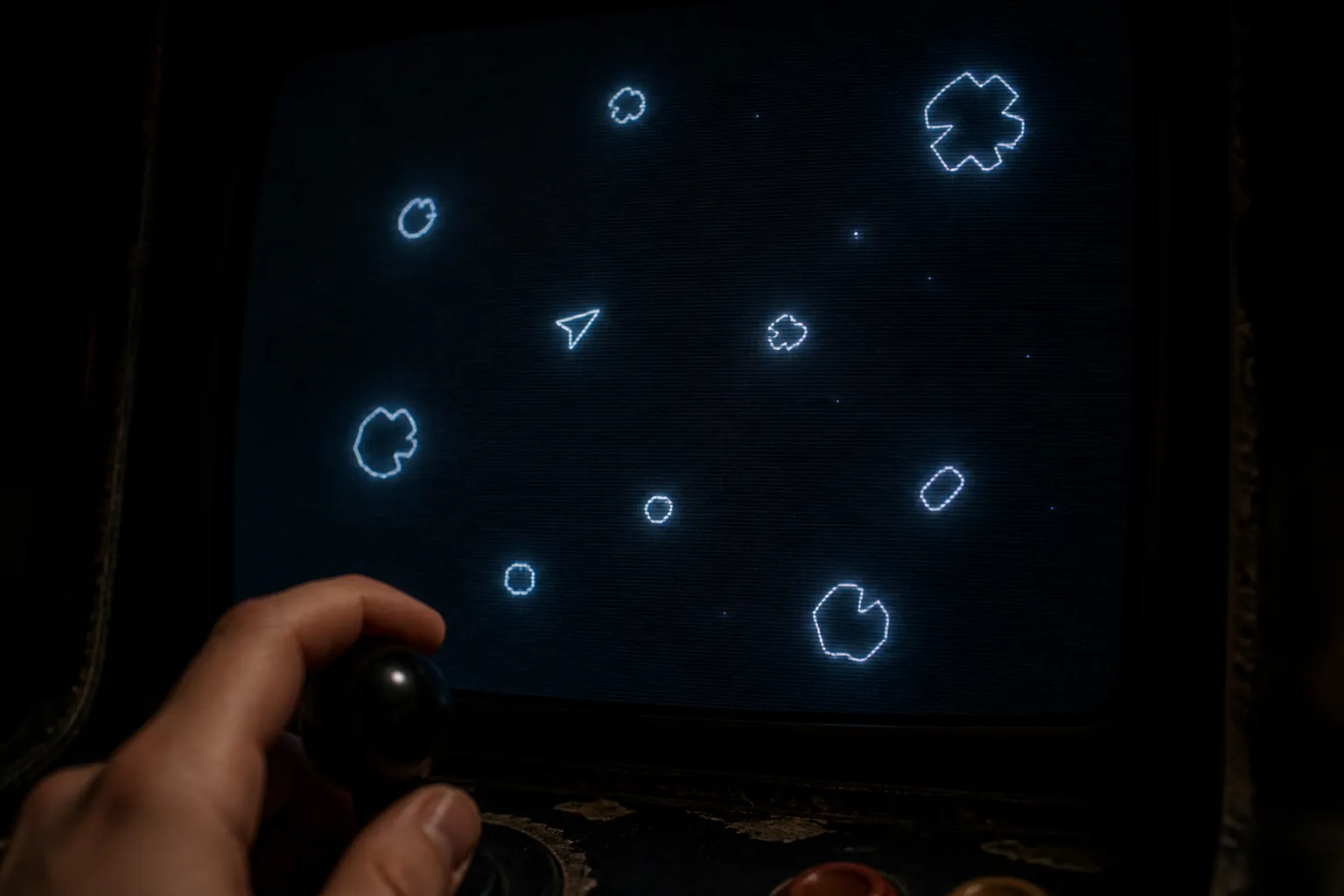
The project on GitHub is an online, browser-based remake of Atari's 1979 Asteroids. It is built on the svision library and draws everything as vector (SVG) lines, so the rocks, saucers and ship echo the original shapes. The same game is in the catalog at /arcade/asteroids-remake if you want to feel it yourself.
The repository labels the work as in progress, dated 2026-11. The core is playable: menu, waves, saucers, hyperspace, initials, a high score table and sound. Settings, an installable web app and a match feature are still pending.
That last item matters most here. A match feature is the one piece that would support head-to-head play. It has not shipped. Today the game is a solo score chase, and a score table is not a competition format.
Why timing fidelity matters for a competitive on-ramp
The remake is a routine-by-routine port of the original program. It runs in a worker at the machine's frame rate, and the sound board is modelled circuit by circuit. That is serious devotion to the source.
Why care? Because fair play needs consistency. Grassroots organisers in any scene will tell you the same thing: people will not show up twice to a game that behaves differently on every device. Frame-accurate timing is a precondition, not a guarantee.
The source establishes the timing model. It does not test whether that model produces fair or repeatable results when people compete on it. Those are different claims, and only the first has support.
The three-minute format as an argument
Here is the case. A short, fixed session lets a newcomer finish a run, read the result and go again. No long queue. No season to commit to. The cost of trying is minutes, not weeks.
I find that persuasive. I also have to say that neither source gives a session length, tournament rules, skill-progression data or retention figures. The length advantage is a hypothesis.
There is a sharper question too. The original's pace was short because players died. The remake adds waves, saucers and a high score table. Nothing in the sources confirms it keeps that pacing, so a skilled player might simply survive for far longer than three minutes.
What the comparison evidence does and does not show
The second source is a merged pull request, #483, dated Nov 19, 2026. It replaces an empty games/asteroids.html with Afterglow, a vector-display roguelite with draft cards. It was compared against an earlier page, Neon Drift, using desktop and phone footage and one fresh critic.
The verdict was about 7.5 for the new version against 5.5 for the old. The category scores:
- First impression: 6 old, 7 new
- Clarity: 5 old, 7 new
- Art direction: 5 old, 8.5 new
- Phone: 4 old, 8 new
- Feel: 6 old, 8 new
Note the history. The first comparison ran before a second commit, and the old page still won on four points, including a first boss that feels like a fight and combo feedback you can feel. The result flipped after a change.
So these numbers measure design polish as judged by one critic. They say nothing about competitive viability. No method, no sample size, no esports outcome. One person's verdict cannot tell us how players of varied skill would respond.
How to test the on-ramp claim
The pull request does offer a useful habit: judge a remake side by side, on the same devices, not by description. Keep that, then measure what esports needs.
- Match outcomes between players, not solo scores.
- Skill spread across new and experienced players.
- Whether results repeat across sessions.
Open questions remain. Does the short format keep people engaged? Would a ranked ladder add value once the match feature exists? Does the 1979 game have any organised competitive history to build on? The sources are silent on all three.
My decision rule is simple. Treat the three-minute arcade format as a promising but unproven on-ramp until playable match support and real session data exist. I am optimistic. I am also waiting for the data.
Sources

Priya Nambiar covers competitive gaming and emerging esports ecosystems for GoAndGame, with a particular focus on Southeast Asian scenes and grassroots tournament culture. She came up through community forums before moving into sports journalism, and that background shapes everything she writes.


