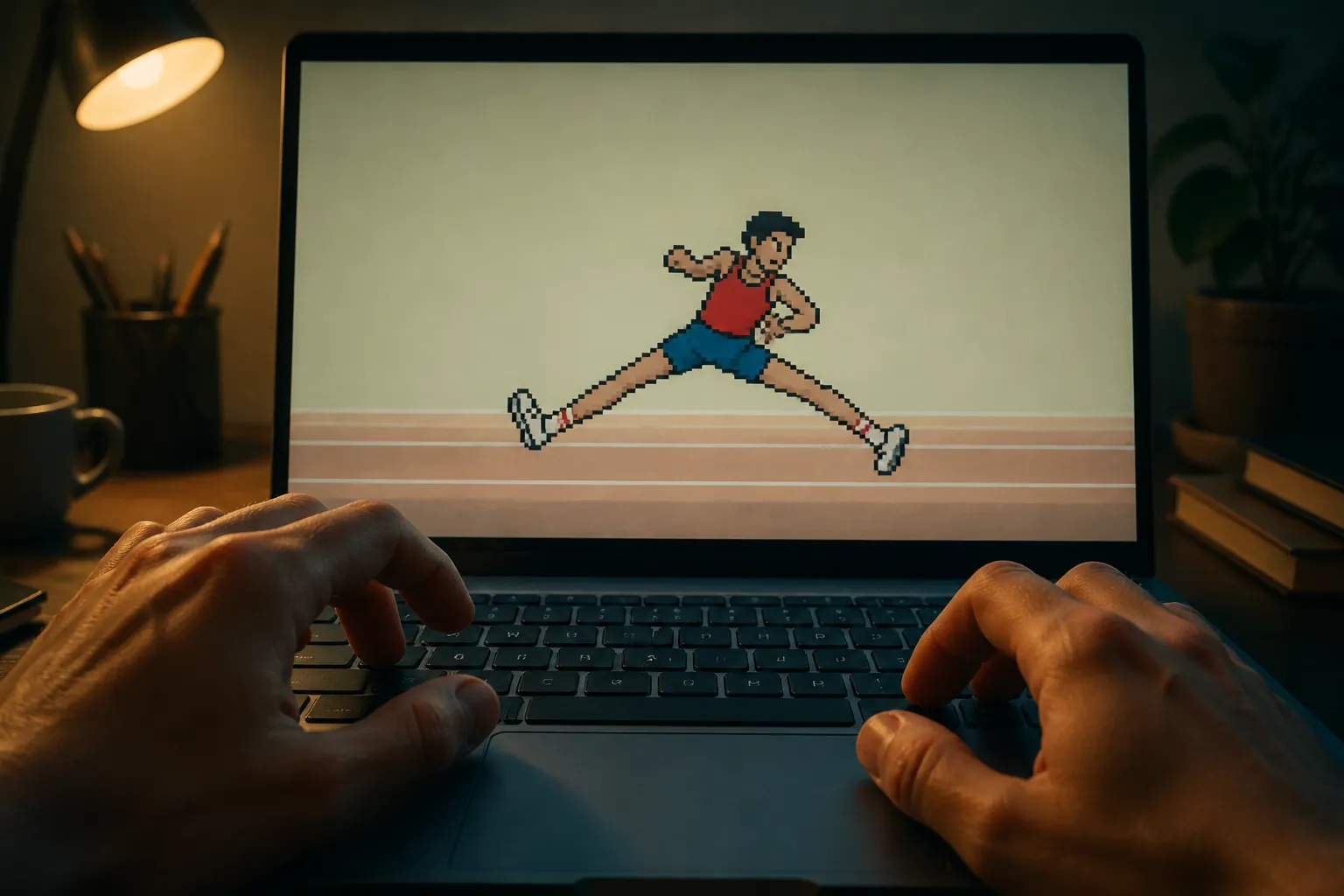
A hundred meters should be a simple distance to imagine. In QWOP, the first step can consume all your attention. You press a key to move part of a leg, watch the runner respond, and try to keep him upright long enough to make another choice. Forward motion matters, but so does surviving the motion you just asked for.
Every step in QWOP is a negotiation between where you want the runner to go and what his body can do next.
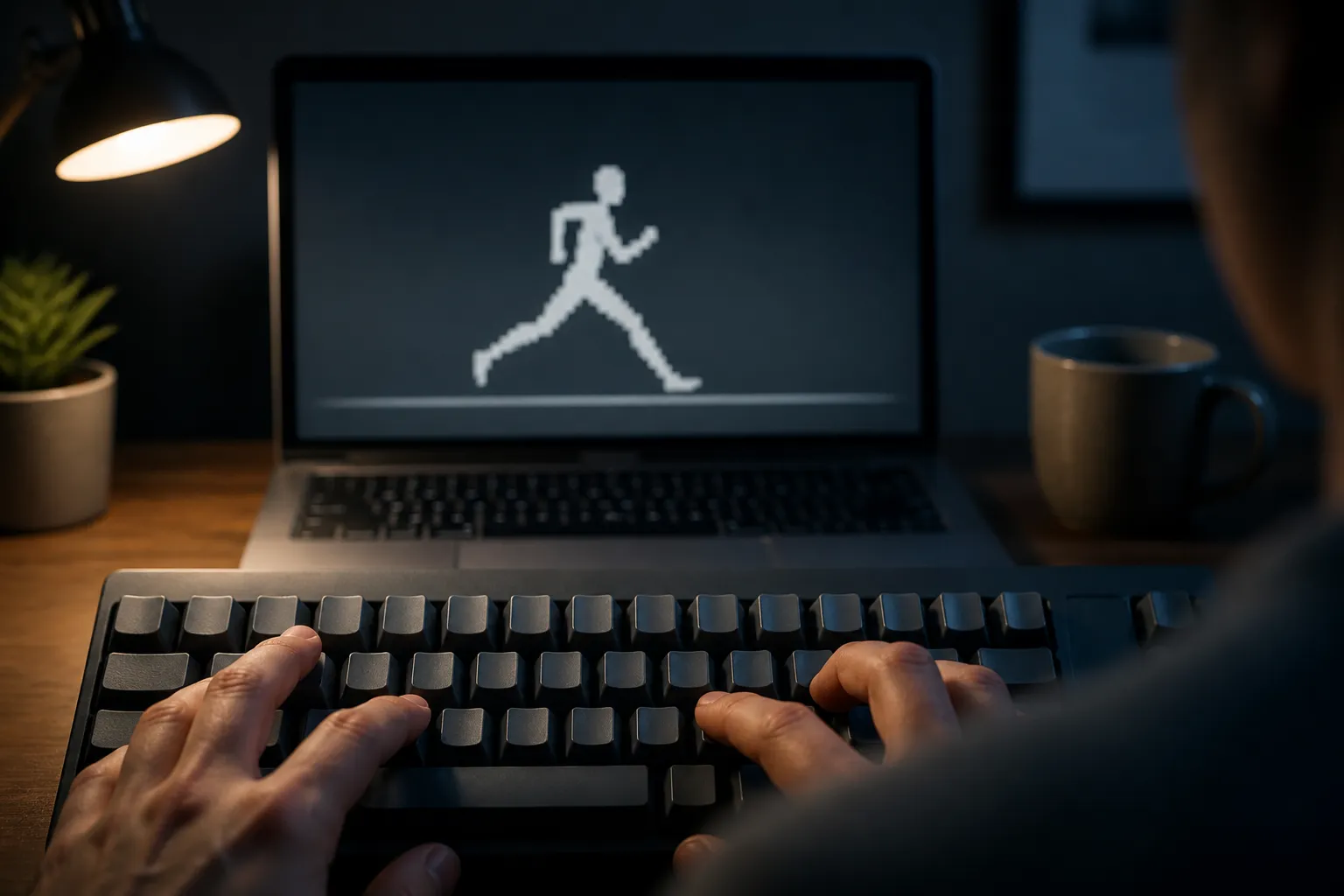
One athlete, four keys, one long straightaway
Released for browsers in November 2008, Bennett Foddy’s QWOP puts a lone athlete in a 100-meter Olympic event. The assignment is to move toward the finish line without falling. That sounds like the usual premise for a sports game until you try to make the athlete move. The race is single-player, and the opponent that demands your attention is balance.
The sports framing gives the struggle a useful scale. A hundred meters is short enough that a finish line feels close. Yet each attempt can become absorbed in a tiny patch of track. A few inches of progress may feel earned because reaching them required several movements to cooperate. The game turns an event measured in seconds into one experienced through individual, uncertain decisions.
A stride you have to assemble
The title names the four keys under your fingers. Q, W, O, and P move the runner’s thighs and calves, with the parts of each leg controlled separately. You cannot tell the athlete to run and let an animation handle the rest. You supply pieces of the action and deal with the position they leave him in.
That division makes timing as important as intention. A leg movement that seems promising on its own still has to work with the other leg and with the runner’s balance. Pressing another key may help him advance, or it may leave too little support for the next movement. The game keeps asking for a fresh decision before the previous one feels settled. Even a successful step does not establish a dependable rhythm for the one after it.
There is a practical answer when the negotiation ends on the ground: R restarts the attempt. Its presence makes failure easy to repeat, but repetition does not turn the controls into a single trick. You can learn to notice how one movement affects the next while still having to respond to the runner’s current position. The distance marker records progress; the athlete’s posture tells you how precarious that progress is.
The same problem under your thumbs
QWOP later reached iOS on December 13, 2010, and Android on July 4, 2013. Foddy published the browser and iOS versions himself; Noodlecake Studios published the Android version. Built in Adobe Flash and HTML5, the game has a history tied closely to the web, even as its controls moved to phones.
On mobile, players move their thumbs around on-screen diamonds to control the legs and arms. That changes the physical conversation with the game. Four named keyboard keys become areas your thumbs travel through, and the input no longer feels like tapping out a sequence of letters. The underlying challenge remains recognizable: you still have to turn separate bodily movements into forward travel while keeping the athlete from falling.
A small game that traveled far
Foddy, an Australian designer based in New York, developed QWOP during his postdoctoral research at Princeton University and his time on staff at Oxford University. He is also known for Getting Over It with Bennett Foddy. His training as a moral philosopher, including work on drug addiction, is part of his background, though it does not by itself explain a particular choice in QWOP’s controls.
By the end of 2010, QWOP had become an internet sensation as new online social sharing tools helped it spread. Its predicament is easy to describe to someone who has never played: four keys, one runner, an unexpectedly difficult race. Watching an attempt can be funny; making one reveals how much concentration sits behind a few awkward meters. The gap between the simple assignment and the effort it takes to carry out gives people something immediate to share.
What the struggle can tell us
The available accounts establish the releases, controls, and broad story of QWOP’s popularity, but they do not offer a detailed critical reception or explain the design decisions behind the control scheme. They also leave scoring, records, and the precise conditions for completing a run undescribed. It would be too easy to turn those gaps into confident claims about what Foddy intended or what counts as the definitive way to play.
The experience at the keyboard supports a narrower, more interesting observation. QWOP asks for a goal everyone understands, then makes the means of reaching it unusually visible. You think about thighs and calves because you must operate them. You think about balance because the runner cannot ignore it. A step forward is no longer an automatic part of running. It is a small agreement among movements that might hold for just long enough to try the next one.

Eliot Reed writes about the intricacies of virtual worlds, blending analysis with storytelling. As a house writer for GoAndGame, he delves deep into game mechanics and narratives, offering thought-provoking insights for players and developers alike.


