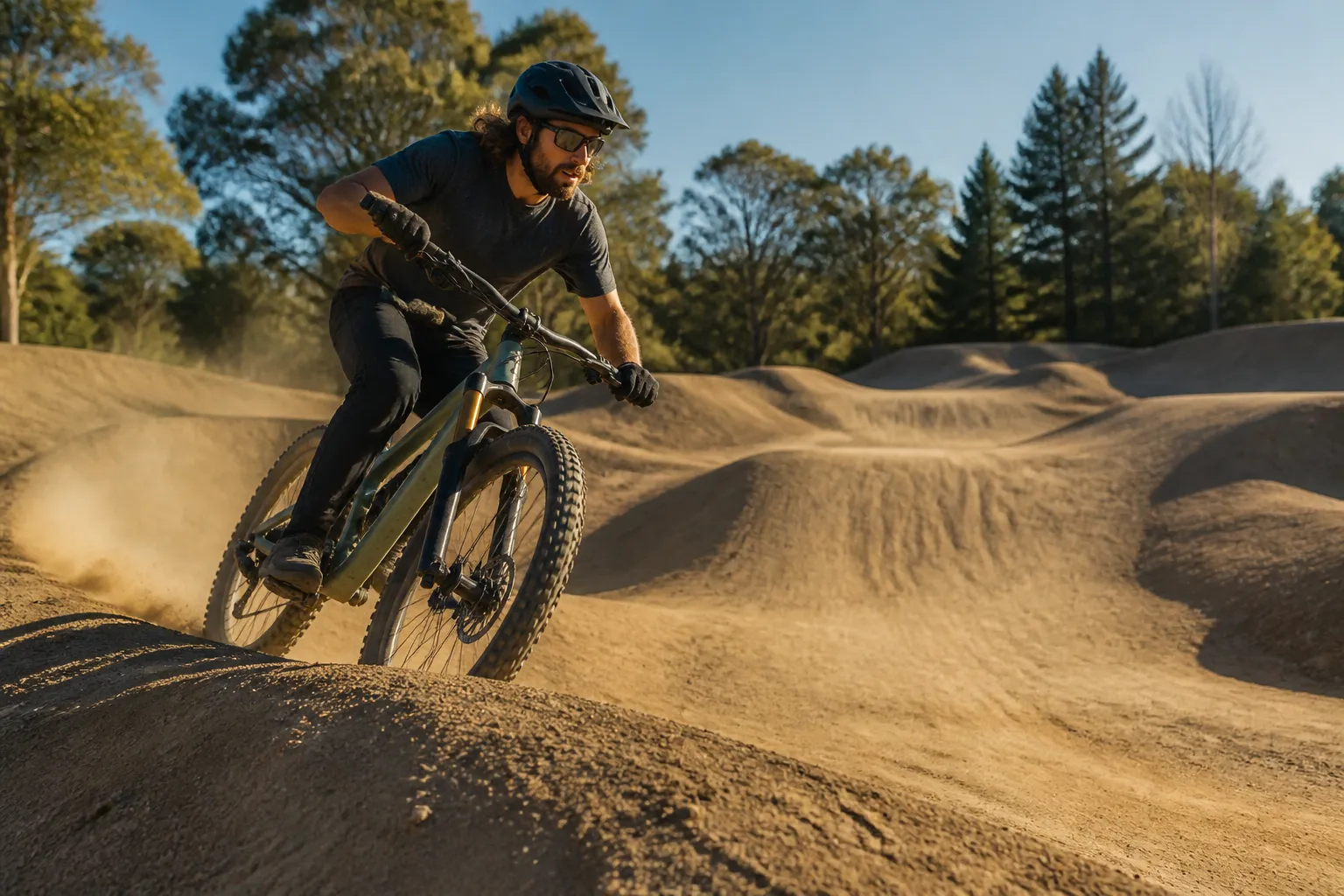
Most pump track runs go wrong in the middle. The start feels fine, the exit is in sight, and somewhere between the two the speed quietly leaks out. This guide is built around five habits for fixing that. One caveat up front: the sources I could use cover the sport's history and backyard building, not the habits themselves. I'll say where that leaves gaps.
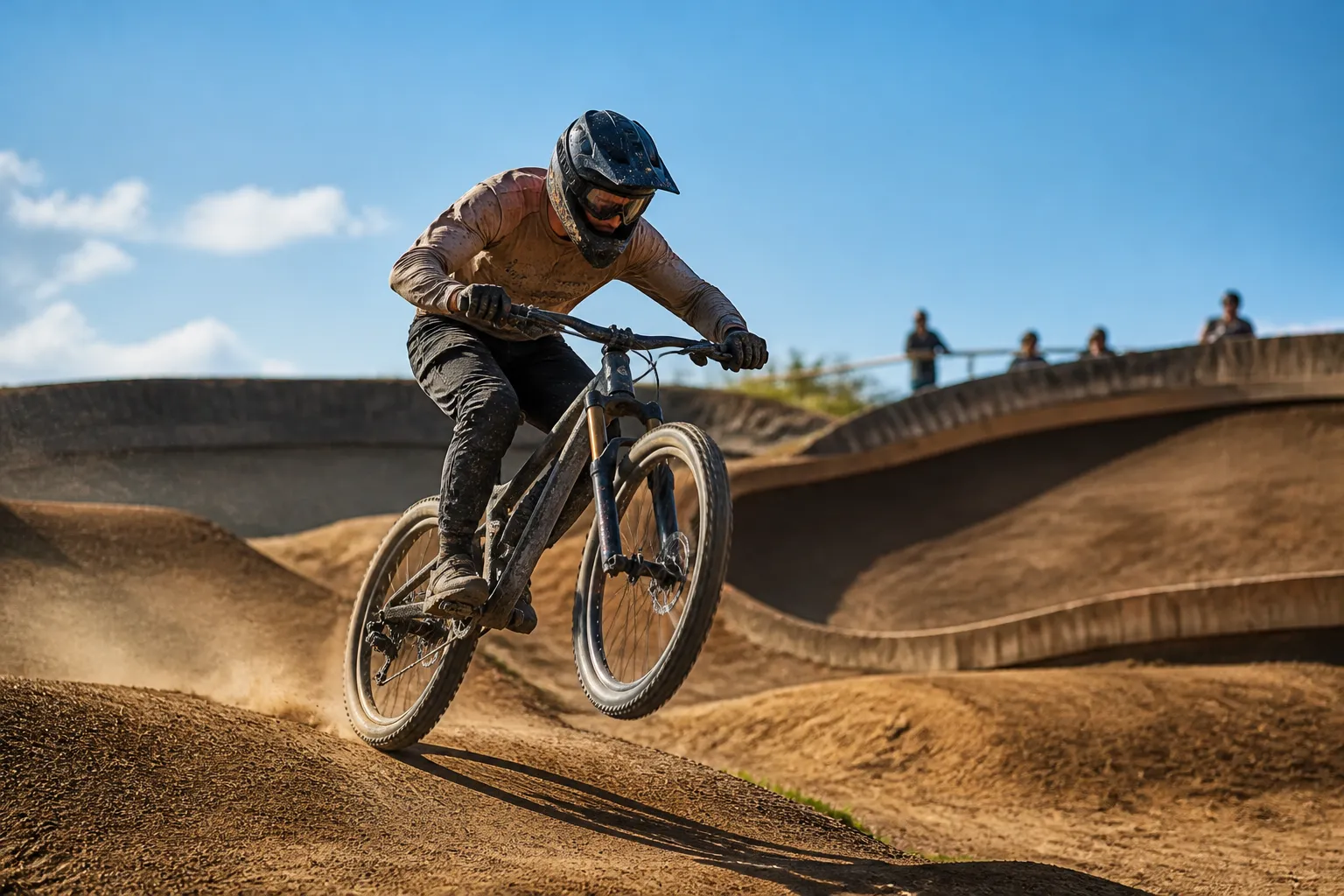
Why the Midpoint Is Where Runs Fall Apart
First, the basics. USA Cycling describes a pump track as a continuous dirt loop of rollers and bermed corners. The goal is to ride the whole loop without pedaling, using a pumping motion to build speed and keep momentum. The same piece calls pumping an essential mountain bike skill and a pump track a good place to practice it.
That is the setup for the midpoint problem. By the middle of the loop you have used the first rollers and the exit is still ahead. Any speed you failed to build early is now gone, and nothing is left to cover for it. The five habits below aim at that stretch. They are my framing, not a checklist lifted from the sources.
Habit One: Pacing Your Effort Across the Loop
The first habit is holding something back early. A rider who attacks the opening rollers hardest can arrive mid-loop with tired legs and arms and less control. Because the loop never stops, a small early mistake rides along with you and grows.
I want to be plain here. Neither the UCI nor the USA Cycling material talks about pacing. Treat this as a working idea to test on your own track, and check it against a coach before you build a routine around it.
Habits Two and Three: Body Position and Line Choice
Habit two is body position. Pumping means loading and unloading the bike through each roller, so how you stand and move decides how much speed the terrain gives back. Habit three is line choice, meaning the path you pick through berms and rollers so you waste as little speed as possible.
The sources name none of the mechanics, so I won't invent any. What they do tell us is that track shape matters. USA Cycling notes tracks can be simple ovals or more complex layouts with multiple turns and straights. A line that works on an oval may not exist on a twisty layout, so learn the track in front of you before you copy someone else's.
Habits Four and Five: Pump Technique and Recovering Speed
Habit four is the pump itself, the repeated push and pull that turns terrain into speed. The idea is clear in the sources. The how-to is not. Anyone wanting real detail should look for instruction from experienced riders.
Habit five is recovering after a mistake. You will clip a roller wrong or come out of a berm slow. The habit is to stay calm and rebuild speed with the next feature instead of forcing it. No source covers this, so I'm offering it as a practice goal, not a proven method.
The five work as a system. Pacing protects your energy, position and line protect your speed, technique makes the speed, and recovery keeps one error from ending the run.
Building and Maintaining a Track to Practice On
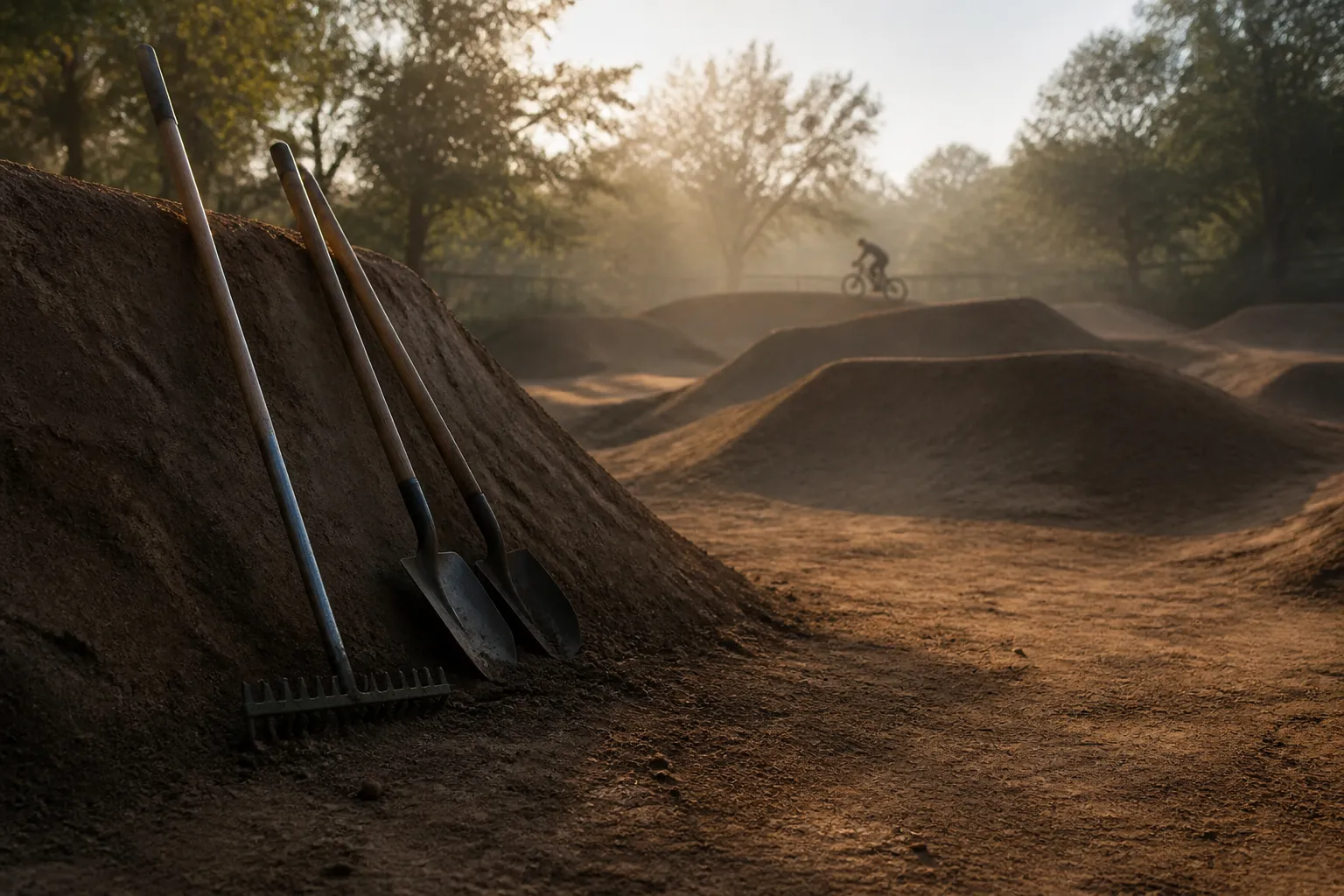
If you want to drill these at home, USA Cycling's backyard guide lists the basic tools:
- Flat shovels for moving and shaping dirt
- Pointed shovels for digging down
- A metal rake for dragging dirt across large areas, shaping berm faces and roller tops, and pulling out stones
What the sources leave out is a long list: dimensions, roller spacing, berm angles, soil choices, costs, labor, maintenance, and safety gear. Don't treat any number as settled until you've read a dedicated build guide. If you just want to play with the idea of a loop first, the Dirt Pump cabinet in our arcade is an easy place to feel how speed carries.
Where the Sport Is Heading
The UCI explainer shows how fast this has grown. The first world championships ran in Arkansas in 2018. The first UCI-sanctioned edition came in 2019 near Bern, with nearly 100 riders from qualifying events. The 2020 edition was cancelled because of Covid-19. Lisbon hosted in 2021 and Santiago in 2022. In 2023 the event went indoors for the first time, at Area 47 in Tyrol, and Christa von Niederhäusern became the first rider to retain a title. Ryan Gilchrist, in 2024, was the first Southern Hemisphere winner. Eddy Clerté became the first man to win twice in 2025.
The 2026 championships are set for 17 October in Mentougou, Beijing, as a standalone event after being part of the 2025 mountain bike worlds.
The UCI also describes the discipline as a mix of BMX racing, mountain bike and freestyle riding. That mix is why a backyard loop is a fair training ground.
Back to the midpoint. The riders in those finals are working the same loop you can build with a rake and a couple of shovels, and the middle of it is where they win or lose too.
Sources
- https://vertexaisearch.cloud.google.com/grounding-api-redirect/AUZIYQE06Up9t31RyjyQvEMd8p24fYMjWJmvI3jSrw2rtHxoeMOVrXbpWmMSlYwcZzH22fWHa2Kui-MLH32v53EtT9fvUM2T0_Zr9MXKdX1QxbF7mWrGSv_g7TWQldXB0HDlzIOFJg0qYRlkKsnElcZYTYTZoLteCk4x9KM5aFurFH_0We6SBpQodErSBn7rX3bcYo9WfEWxdrSl9GxTSxrieD8E1Xeziu7PvcEYQEA5MpNleHBx5dfI
- UCI Pump Track World Championships: a brief history and explainer | UCI
- How To Build a Backyard Pump Track | USA Cycling

Mara Solis is a staff writer at GoAndGame covering board games, tabletop strategy, and the culture around competitive play. She has spent years logging hours at game tables from local hobby shops to international conventions. Her writing blends practical insight with a genuine enthusiasm for the communities games create.


