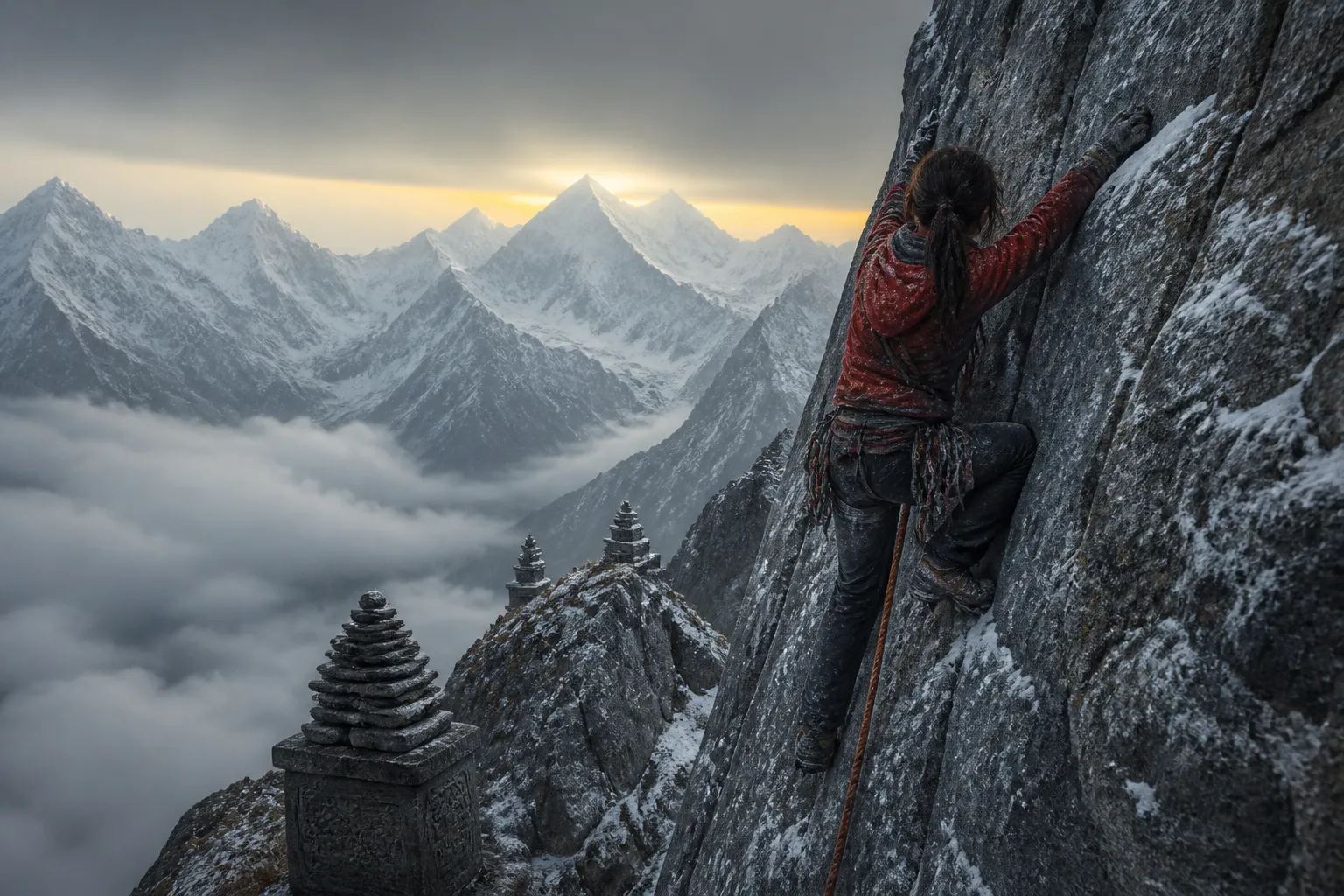
Aava has chosen a difficult way to be alone. In Cairn, she sets out to become the first person to summit Mount Kami, a fictional Himalayan-style peak no one has climbed. The mountain gives her few opportunities to explain herself. Instead, the game asks us to watch what she does when the rock offers almost nowhere to put a hand.
The premise: a climb with no one else on it
For most of the ascent, Aava is alone. Kami was once home to a tribe, and its remnants offer traces of other lives, but there is no companion beside her to turn each hard stretch into a conversation. The stillness matters. With so little said aloud, an extended pause at a rock face can feel as revealing as dialogue. We look for intention in where she goes next and in her refusal to turn back.
That silence also leaves room for doubt. A first ascent is an achievement people can name and celebrate, but no audience is waiting on the rock with her. IGN’s review describes Cairn as challenging and rewarding. The more interesting question is what those rewards mean to Aava. A summit might satisfy an ambition. It cannot, by itself, explain why she accepts the danger of getting there.
Controls as character
Cairn makes attention feel physical. The player moves Aava’s limbs, guiding hands and feet toward imperfections in the stone. Fingers find cracks. Toes settle on small ledges. From a distance, a stretch of mountain might look like one continuous wall; close up, it becomes a collection of possible holds, each demanding a judgment. Progress begins with looking carefully.
That shift in vision is one of the game’s strongest ways of bringing us close to Aava. We are not simply directing her toward a destination. We learn to read the rock as she must, searching for an opening and deciding what her body can reach. When a route starts to make sense, the insight feels shared. Her expertise takes shape through the player’s attention rather than through a speech about who she is.
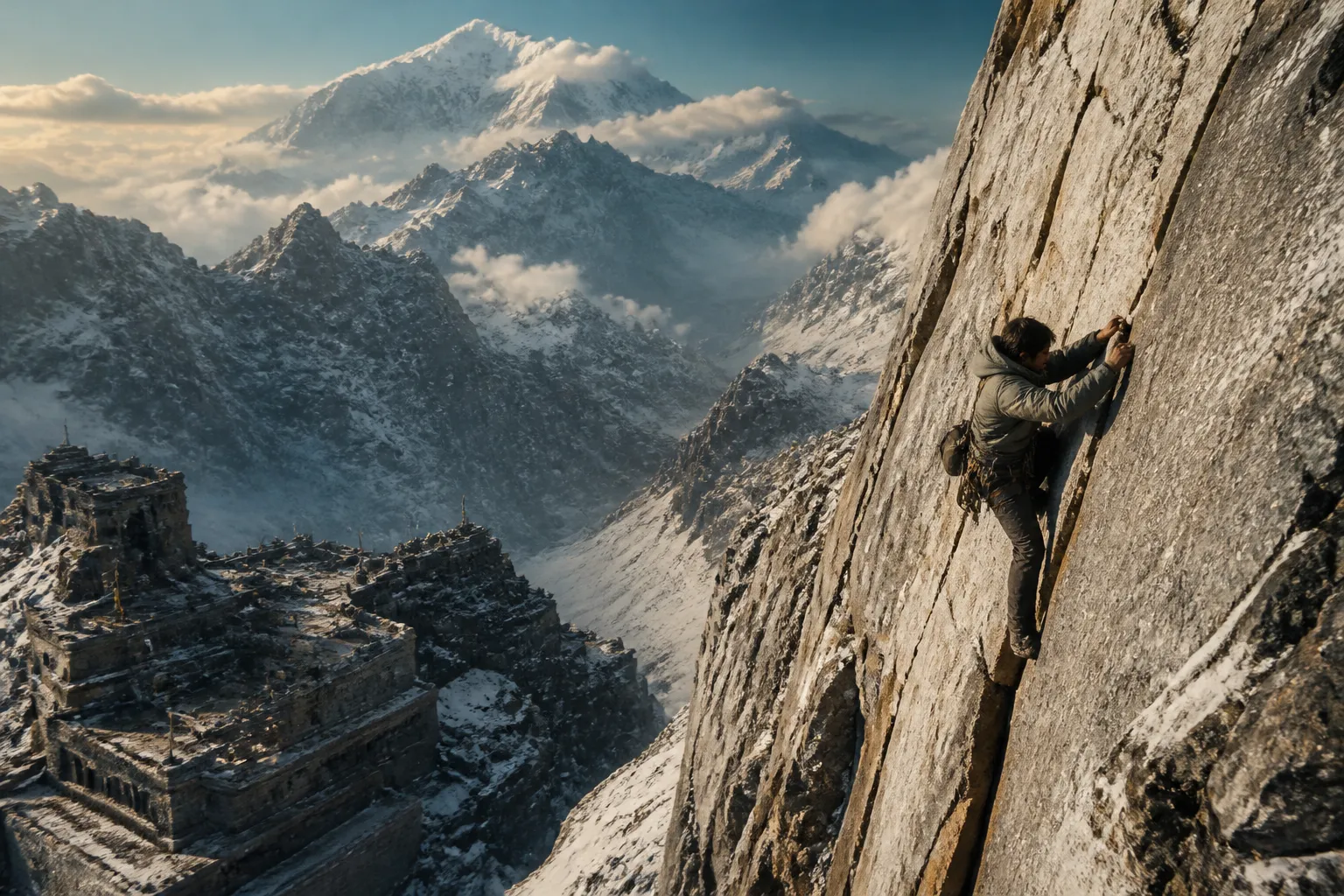
The closeness can be uncomfortable. Placing a limb asks for patience even when the goal is visible above. The mountain keeps narrowing a grand ambition to the scale of a fingertip. The Guardian’s review calls the climb an intimate test of endurance, fixation and emotional resolve. Those words fit because Cairn makes the work of continuing hard to overlook. We spend time with the effort that an account of a successful ascent might compress into a single sentence.
This is also where difficulty earns its place in the portrait. A hard section can make Aava’s persistence admirable, then make that same persistence seem troubling a moment later. The controls give us no easy way to separate determination from compulsion. We keep placing her hands on the rock, even as we begin to wonder what she hopes the next hold will prove.
Why she keeps going
Aava’s desire for transcendence gives the climb a language larger than achievement. It suggests she wants an experience that changes how she understands herself. Yet Cairn ties that wish to stubbornly material work. She cannot reach beyond the ordinary without first finding somewhere for her foot to go. That tension keeps the idea from floating away into abstraction.
There is awe on Kami, but awe does not settle the question of motive. A person can be moved by a mountain and still become fixated on conquering it. Aava’s solitude sharpens that uncertainty. Without another climber beside her to challenge her choice, we are left to weigh the evidence of her movement: another careful placement, another section climbed, another decision to continue despite the danger.
The game’s most persuasive character study may lie in that repeated decision. Resolve and obsession can look remarkably similar from the outside, particularly when the work is difficult and the goal remains far away. Cairn does not need every hold to deliver a new revelation about Aava. The accumulation matters. By making us participate in the climb, it lets us feel how a purpose can sustain someone while also taking more from them than they expected.
What the climb leaves open
A close reading of Aava has limits. The available reviews do not establish how her backstory unfolds or what happens at the end of her journey. They also do not explain the game’s difficulty settings or detail survival systems such as supplies and falls. Those omissions matter when judging claims about what the whole game ultimately says. Its portrayal of climbing should not be treated as a guide to real mountaineering, either; the cited reviews do not assess its accuracy on that ground.
What we can see is more specific, and more compelling. Aava chooses an unclimbed mountain, spends much of the journey alone, and meets its surfaces with her hands and feet. Cairn lets those concrete acts carry questions that a fuller biography might answer too neatly. Each crack in the rock offers a way upward, but no certainty about why she needs to take it.
Sources

Alexandra Rivet explores the intricate interplay of games and culture for GoAndGame. A passionate storyteller, she delves into narratives with depth and curiosity. Her pieces often highlight the stories behind the pixels.


