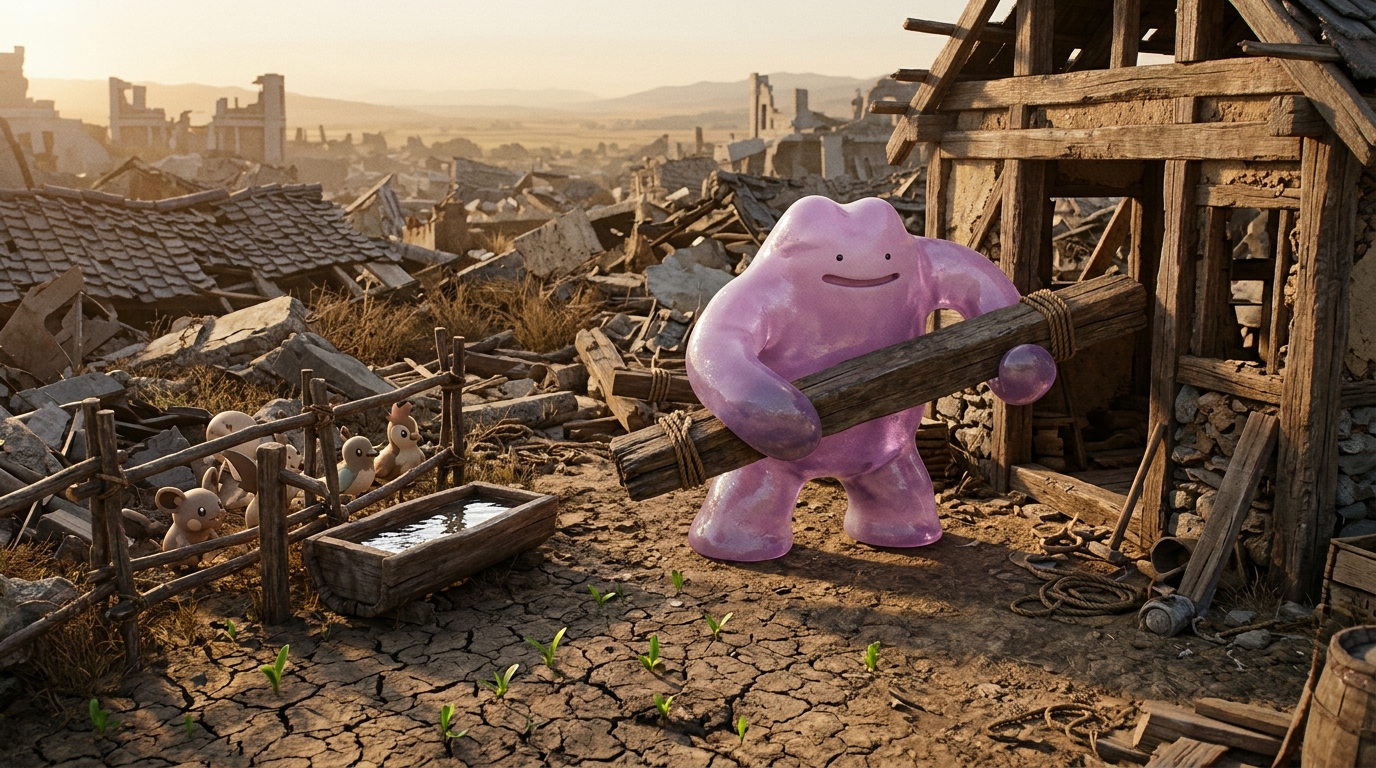
Fuchsia City is a strange place to begin a Pokémon game. In Pokémon Pokopia, its buildings have been reduced to rubble, and the surrounding Kanto region is suffering through a drought. The player arrives not as a trainer looking for a team, but as a Ditto in a roughly human shape. The immediate question is what it would take to make this place livable again.
A Ditto in the ruins
Pokopia is a building and town simulator about turning empty land into somewhere Pokémon can settle. That gives its familiar setting a different purpose. Fuchsia City is not simply a stop on a journey. Its condition is the starting problem, and rebuilding comes before any sense of expansion.
Ditto is a neat choice for this work. A Pokémon known for changing form becomes the person who changes the surroundings. The premise draws attention away from collecting creatures and toward their daily needs: space, shelter, and a reason to stay. The appeal of seeing Pokémon inhabit a place is easy to understand. A town feels different when the creatures around it seem to have lives there, rather than waiting for a trainer to pass through.
Rebekah Valentine’s IGN review, updated March 5, 2026, describes Pokopia as an enjoyable, personality-packed builder in a surprisingly deep world. The pairing of Pokémon with a life sim has a credible pedigree, too. Developer Koei Tecmo’s Omega Force previously worked with Square Enix on Dragon Quest Builders 2. That connection does not tell us exactly how Pokopia plays, but it helps explain why its construction premise deserves attention on its own terms.
The work of making room
The reported loop begins with the Pokémon Ditto meets. They teach it new moves, which the player can use to expand the space and continue building. Growth therefore seems tied to encounters as well as materials: meeting another resident can change what the player is able to do with the land. For a game about making a home, that is a fitting relationship between community and progress.
Berries, rocks, and wood are among the resources players collect. The available descriptions connect gathering to furniture building and vegetable growing, small tasks that give reconstruction a domestic scale. A repaired city is an enormous goal. A piece of furniture or a planted vegetable is something the player can imagine a Pokémon using. Pokopia’s premise gains force from that shift in scale, from the ruins of Fuchsia City down to the contents of a room.
There are limits to what these details establish. They outline a promising rhythm of meeting, learning, gathering, and building, but do not explain the exact demands of construction or how much freedom the player has in laying out a town. Valentine’s description of a deep world is an encouraging assessment, not a substitute for those particulars. Players who enjoy the routine of shaping a settlement may find the premise inviting. Those who need to know how its systems behave over many hours still have questions to ask.

What an 88 can tell us
Pokopia also arrived with a striking point of comparison. IGN reported that, as of March 3, 2026, its Metacritic Metascore was 88. That tied Pokémon Y for the highest score among Pokémon games on the site. Pokémon X stood at 87, alongside Pokémon Moon, HeartGold, Black, White, SoulSilver, and Sun.
That placement matters because Pokopia asks for a kind of attention that the series’ best-known adventures do not. Its score put a game about rebuilding and habitation beside entries remembered for traveling, training, and battling. It suggests critics found substantial value in spending time with Pokémon in a different way. It does not mean a player who wants a conventional Pokémon journey will find an equivalent one here.
The same 88 also placed Pokopia alongside 2026 releases including Mewgenics, Esoteric Ebb, and Resident Evil Requiem in the comparison IGN reported. Those games have little reason to satisfy the same tastes. A Metascore is useful context for Pokopia’s early reception, but its number cannot answer the more personal question of what a player wants to do each evening after returning to the game.
Who should consider moving in?
Pokopia looks most suited to someone drawn to a builder with Pokémon personality: a player who likes the thought of gathering wood, growing food, and gradually seeing residents occupy a place that once lay empty. Its ruined opening gives that work a clear emotional direction. Each useful object can feel like part of a recovery rather than an addition to a collection.
The dividing question is how much the player wants to build compared with how much they want to battle. The available accounts frame Pokopia around making a place for Pokémon to live. Anyone primarily seeking the structure of a traditional Pokémon adventure should take that framing seriously, even with an excellent early Metascore. Likewise, a dedicated simulation player may want more detail about the construction systems than these accounts provide.
There are practical unknowns, too. These sources do not supply a price or platform list, explain multiplayer features or completion time, or lay out specific criticisms from the review. Those are worth checking before making a purchase decision. What is clear is Pokopia’s starting proposition: Fuchsia City is broken, Ditto can learn from the Pokémon it meets, and the work ahead is to give them somewhere to live. That is a compelling use of Kanto, provided the act of building appeals as much as the destination.
Sources

Eliot Reed writes about the intricacies of virtual worlds, blending analysis with storytelling. As a house writer for GoAndGame, he delves deep into game mechanics and narratives, offering thought-provoking insights for players and developers alike.


